
Population ageing, including the point at which older adults outnumber younger people, is a global demographic phenomenon. Credit: Shutterstock
By Joseph Chamie
PORTLAND, USA, Jul 20 2026 – In many countries, older adults (aged 65 and above) now outnumber younger individuals (under the age of 18), reflecting a significant demographic transformation known as demographic ageing.
The shift in a population’s age structure is becoming increasingly common around the world and is primarily driven by declining fertility rates and rising life expectancy. As populations age, societies face a range of economic, political, and social challenges.
Economically, an ageing population can lead to labor shortages, slower economic growth, and a shrinking tax base. These changes can make it more difficult for governments to finance pensions, healthcare systems, and other public services.
At the same time, the growing number of older adults increases demand for specialized healthcare services, including geriatric care, assisted living, and the treatment of chronic illnesses, placing additional strain on healthcare systems.
To promote sustainable growth and social equity, governments should seek to balance the needs of older adults with those of younger generations, ensuring that public resources support both present well-being and future development
Politically, as people live longer and represent a larger share of the electorate, older adults may gain greater political influence. Their increased voting power can shape government spending priorities, potentially leading to a larger share of public funding being allocated to pensions, healthcare, and retirement benefits, while comparatively less is invested in education, childcare, and programs that support younger generations.
Overall, demographic ageing is reshaping societies worldwide, creating both opportunities and challenges. These developments require governments to adopt balanced policies to ensure economic sustainability and intergenerational equity.
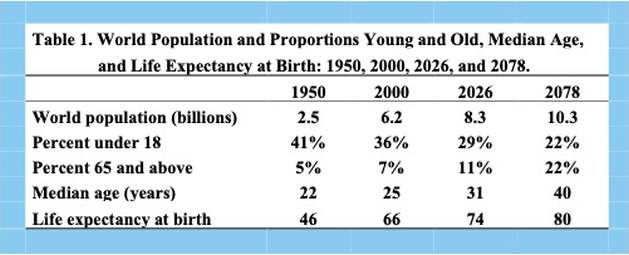
In the middle of the 20th century, older adults accounted for 5% of the world’s population of approximately 2.5 billion, while young people comprised 41%. At that time, the median age of the global population was 22 years. By the end of the 20th century, the world’s population had grown to 6.2 billion, although the age distribution changed only modestly.
In 2000, older adults represented 7% of the global population, while young people represented 36%. Meanwhile, the median age increased to 25 years, indicating a gradual ageing of the global population.
Despite the rapid growth of the world’s population during the second half of the 20th century, the proportion of older adults increased at a much slower pace. These changes mark the early stages of global demographic ageing, characterized by a gradual increase in the share of older adults and a corresponding decline in the proportion of younger people (Table 1).
Source: United Nations.
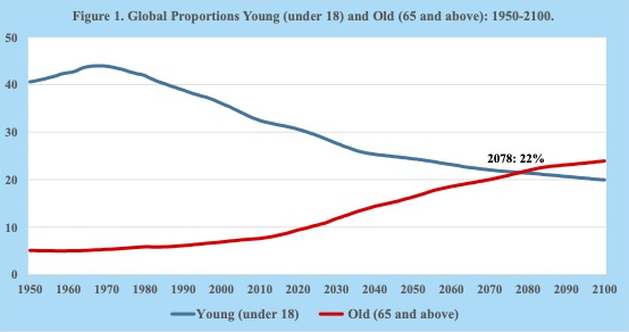
By 2026, the world’s population had reached approximately 8.3 billion. At the same time, young people accounted for an estimated 29% of the global population, while older adults represented about 11%, and the median age had risen to 31 years. By 2078, these two age groups are projected to account for equal shares of the global population, which is expected to reach 10.3 billion, with each group accounting for approximately 22% of the total population (Figure 1).
Source: United Nations.
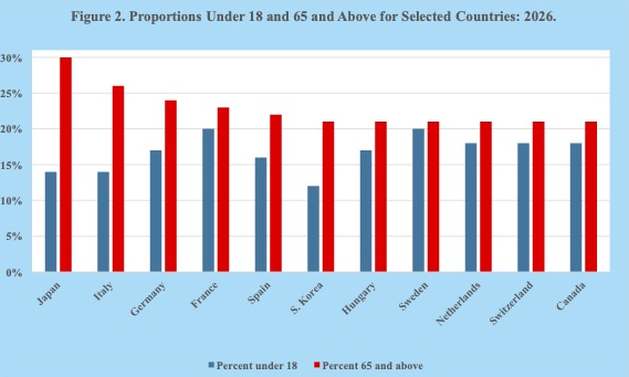
In 2026, approximately 50 countries and territories have a higher proportion of older adults (aged 65 and above) than young people (under the age of 18). This demographic pattern is most common in the more developed countries, which tend to have lower fertility rates and longer life expectancies.
In Italy and Japan, for example, the proportion of older adults (aged 65 and above) is roughly twice that of young people (under the age of 18). Similarly, European countries such as France, Germany, Hungary, the Netherlands, Spain, and Switzerland also have substantially larger shares of older adults than young people (Figure 2).
Source: United Nations.
Demographic ageing, together with the changing proportions of older and younger populations, has significant economic, social, and political consequences.
Among the most important effects of demographic ageing are shrinking workforces, a growing proportion of retirees, rising dependency ratios, increasing pension expenditures, mounting healthcare costs, shifting political and budgetary priorities, and adapting institutions to the needs of ageing populations.
As populations age, more retirees receive pension benefits for longer periods, while a relatively smaller workforce contributes to the pension systems. Consequently, fewer workers are required to support a much larger non-working population, placing substantial pressure on public finances and social security systems. In response to labor shortages associated with shrinking workforces, many governments have introduced policies that encourage older adults to remain in the labor market for longer.
Healthcare expenditures also rise as populations age. Older adults typically require more medical care than younger people because they are more likely to experience chronic diseases, multiple health conditions, and complex healthcare needs.
As a result, demand for healthcare services such as rehabilitation, dialysis, dementia care, and long-term care continues to increase. In many countries experiencing rapid demographic ageing, governments and families face growing financial and caregiving responsibilities to support an expanding older population.
Meeting the care needs of an ageing population often creates tension over responsibility between governments and families. Governments may expect family members to assume primary responsibility for caring for older adults, while families frequently believe that governments should provide greater support and resources to meet the needs of their ageing relatives.
Some conservative and authoritarian governments argue that extensive public spending on elder care generates limited economic returns because older adults are viewed primarily as recipients of care rather than contributors to economic productivity. As a result, these governments often contend that rising healthcare and long-term care expenditures for older adults may constrain economic growth and advocate limiting public investment in these services.
Similarly, many conservatives and some policymakers often believe that caring for older adults should be the responsibility of individuals and their families, with the private sector playing a greater role rather than government in delivering care and support.
According to the World Health Organization (WHO), common health conditions associated with older age include hearing loss, cataracts, back and neck pain, osteoarthritis, chronic obstructive pulmonary disease (COPD), diabetes, depression, loneliness, dementia, and mobility limitations. Many older adults experience several of these health conditions at the same time, making their healthcare needs more complex and requiring coordinated, long-term management.
Older adults who require long-term care are disproportionately women aged 80 years and older who live alone. This group is particularly vulnerable to social isolation which is associated with poorer mental and physical health outcomes, including increased risks of depression, cognitive decline, chronic illness, and reduced quality of life.
In contrast, young people are more likely to face health issues such as injuries from road traffic accidents, falls, drowning, violence, self-harm, depression, anxiety, substance use disorders, asthma, and maternal health conditions.
Population ageing, particularly the increasing prevalence of chronic health conditions and the growing demand for long-term care, has significant implications for government policies and public programs that affect people of all ages. As these trends intensify, they place growing pressures on public resources and influence electoral priorities, shaping decisions about healthcare, social services, education, and public spending.
As older adults make up a larger share of the voting population, governments often place greater emphasis on policies that address the needs of these older adults, particularly pensions and healthcare. As policy priorities shift, investment in areas that primarily benefit younger generations – such as education, infrastructure, and long-term economic development – may decline.
To promote sustainable growth and social equity, governments should seek to balance the needs of older adults with those of younger generations, ensuring that public resources support both present well-being and future development.
Demographic ageing also presents difficult fiscal and political challenges. Governments may need to consider measures such as raising taxes, reducing pension benefits, increasing the retirement age, or implementing other fiscal reforms to ensure the long-term sustainability of public finances.
However, governments often delay implementing these reforms because they are politically unpopular. As a result, financial pressures on pension and healthcare systems continue to grow, increasing the risk of substantial funding shortfalls, or, in some cases, insolvency if reforms are postponed for too long.
Population ageing, including the point at which older adults outnumber younger people, is a global demographic phenomenon. As this demographic transformation continues across countries, governments face the ongoing challenge of adapting their economic, political, and social institutions to meet the needs of different age groups – particularly younger and older generations – while maintaining fiscal sustainability and promoting intergenerational equity.
Joseph Chamie is a consulting demographer, a former director of the United Nations Population Division, and author of numerous publications on population issues.